



2024-09-24
IHI Corporation/The passion behind Toyosu urban development

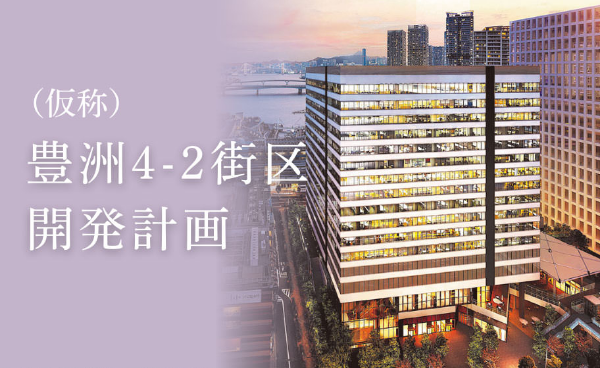
Founded in 1853 as Ishikawajima Shipyard, IHI has continued to run at the forefront as one of Japan's leading heavy machinery manufacturers, despite undergoing repeated business transformations. Since closing its Tokyo 1st Factory in 2002, the company has been working on the redevelopment of Toyosu for many years, and is nearing completion. We spoke with Kazutake Kodaira, Group Manager of the Business Operations Group in the Urban Development SBU of the Social Infrastructure Business Domain, and Nao Kaneko of the Business Planning Promotion Group, about the urban development of the Toyosu area and the thoughts behind the "Toyosu Sail Park Building(provisional name: Toyosu 4-2 Block Development Plan)(hereinafter referred to as Toyosu Sail Park)," the final piece of the Toyosu 2-3-chome district development.
PROFILE
IHI Corporation
Founded:1853
Number of employees: 28,237(asof the end ofMarch2024)
Head office location: Toyosu IHI Building, 1-1 Toyosu 3-chome, Koto-ku, Tokyo
Business description: Based on the technology cultivated in the shipbuilding business, we are involved in resources, energy, environment, social infrastructure, industrial systems, general-purpose machinery, aerospace,
We have expanded our business to four defense fields and provide cutting-edge technology and products in each field.
From the shipyard days to the town's opening in 2006
In 2002, when the company was still called Ishikawajima-Harima Heavy Industries, the Toyosu Tokyo No. 1 Factory was closed. We asked Kodaira, who still remembers the area's days as a shipyard, about his impression of Toyosu in the past.
Mr. KodairaWhen I joined the company in 1999, there was a shipyard on the sea side, and shipbuilding and ship repair were still actively carried out. In the area where the Toyosu IHI Building currently stands, there was a technology development research institute and factories for several products. The areas around where we have been redeveloping were also called coal and steel wharves during the Showa era, and were industrial areas where coal and steel products were loaded and unloaded.
First, Toyosu Center Building was Completion in 1992. The site was originally the location of our company dormitories and housing, but as these were closed early on prior to the plant's operation, an office building was constructed first. After that, the completion of the Toyosu IHI Building in 2006 marked the start of Toyosu town development in earnest.
KanekoNext, Shibaura Institute of Technology was built, Toyosu Park opened, and then Toyosu Center Building Annex and LaLaport Toyosu were completed around the same time, and urban development progressed rapidly.
Mr. Kodaira: First, we demolished the factories all at once and developed the infrastructure of the town. Buildings were built little by little on a vast vacant lot, which threw off the sense of scale.

Toyosu, the city of "timeless fashion"
With the completion of Toyosu Sail Park, the final piece of the Toyosu 2-3-Chome area, approaching in 2025, what are your thoughts on the future development of Toyosu?

Mr. Takeshi Kohei,Group Manager, Business Operations Group, Urban Development SBU, Social Infrastructure Business Area
Mr. Kodaira: I think the phrase "futeki ryuko" (unchanging time and vigor) will apply to Toyosu in the future. Rather than a scrap-and-build approach in which the old is discarded and replaced with something new, I envision a town that continues to change in line with the functions and needs required in each era, a town that adapts to the times.
*While not forgetting the essential things that never change, we also incorporate new things that are constantly changing.
If we don't continue to change with the times, we will no longer match the needs and the "people" that are the basis of urban development will leave. By attracting "people", activities will be born, bustle will be created, and various people will cooperate in movements that improve the quality of life of the town itself... That's how I envision the town of Toyosu to continue.In fact, I feel that in recent years, people who want to create activities and take on new initiatives are gathering in the town of Toyosu.
Kaneko: Toyosu Sail Park is the last piece of our redevelopment in the Toyosu 2-3-chome area, so we would like to work with Mitsubishi Estate to contribute to the entire Toyosu area. As the phrase "futeki ryuko" (unchanging and ever-changing) suggests, we are involved in the development with the hope that "Toyosu will become a place where we can preserve the good things while incorporating new things."
Mr. Kodaira: I would be happy if the children of the residents living in the Toyosu area wanted to live in Toyosu again when they grow up. Of course, I'm also looking forward to seeing new people who find Toyosu attractive move in as the times change, and to seeing the town change even more. One of the factors that will make this kind of urban development a reality is the vision of a "multi-purpose city that combines work, living, leisure and study."
A complex city that offers work, living, play and study
"Urban Development Guidelines"
Although it has a long history, it also has something new that constantly attracts people, and is a city that is "unchanging and changing" with people coming and going with each generation. To achieve this, four elements are essential: "work, live, play, learn."
Mr. Kodaira: It's an office district, a residential area, a place where people from outside can come and play, with commercial and tourist facilities, and a place to study. Measures for residents also have a positive impact on workers, and the system that targets visitors has a positive effect on local life. There are more opportunities for positive interactions than with a single use alone. Of course, I think it's possible to create a comfortable town with just living and working, or just living and studying, and there are many areas around the country that are actually developing in this way. However, I think that in Toyosu, the combination of these four elements has created a synergistic increase in opportunities.
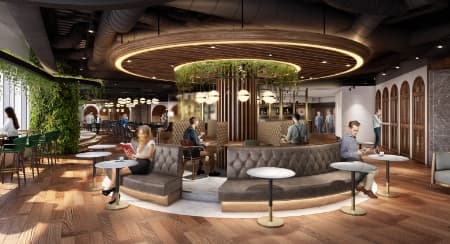
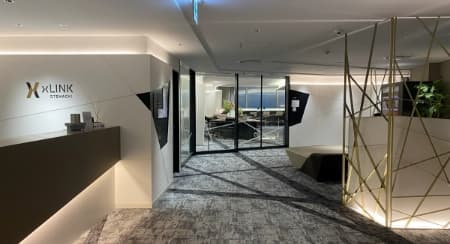
Kaneko: When I explain about the Toyosu area, I first say that it's a city where you can work, live, play and study. To accelerate this, we are currently working on the development of incubation facilities and corporate dormitories at Toyosu Sail Park. This is an initiative to create a community and new lifestyles by having workers and residents interact with each other starting from this facility.
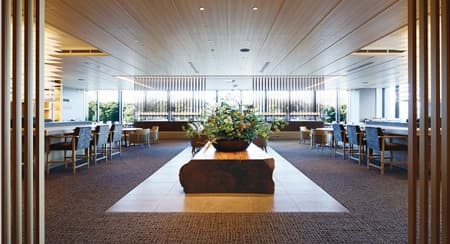
In addition to incubation facilities and corporate dormitories, we are working on developing hard aspects such as terrace spaces, pet-friendly commercial facilities, and outdoor spaces and office entrances that encourage dialogue. We also intend to create systems that will encourage communication on the soft side, but the challenge for the future is how to involve people with different attributes. However, we hope that as all the elements of work-life-learning-learning come together and dialogue progresses, a good chemical reaction will occur and we will see an even more evolved version of "work-life-learning-learning" in Toyosu.

Nao Kaneko,Business Planning Promotion Group, Urban Development SBU, Social Infrastructure Business Area
The development, which has been going on for approximately 20 years, has involved collaboration between many businesses, including IHI and Mitsubishi Estate.
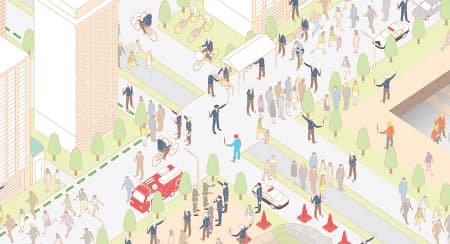
In order to make Toyosu a unified, comfortable space, "Urban Development Guidelines" have been established.

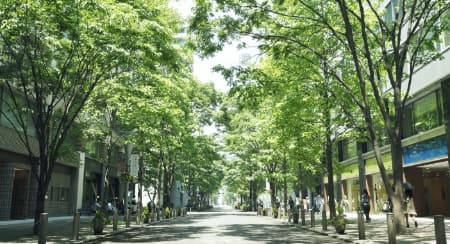
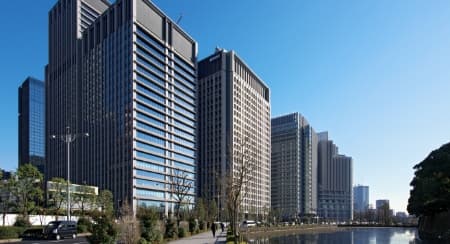
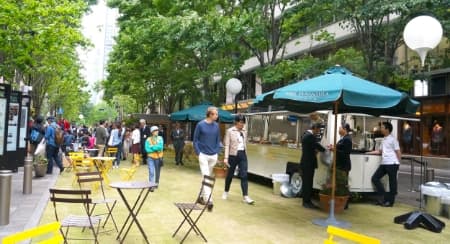
Mr. Kodaira: The redevelopment area is regulated by the "District Plan" that the land area for building must be at least 3,000 m2. In reality, the area is regulated at 10,000 m2 or more, and the area is now a Area of open office buildings with spacious, flexible floor spaces. In terms of external spaces such as roads, the "City Development Guidelines" prohibit the erection of fences on the boundaries between public sidewalks and private land, and standardize the paving materials and paving patterns, creating a sense of openness. Furthermore, the guidelines stipulate that the first floor of buildings should be used as stores, showrooms, rest areas, etc. as much as possible in order to create a city where "people are the main focus."
Because of this sense of unity, I personally feel that it is a very pleasant and easy place to live. There are bustling spaces where people can stay, and there is plenty of greenery and waterside. It is a multi-purpose city, so there are workers and elderly people. There are children jumping into the water, people walking their dogs, students, and the city is full of energy.
Kaneko: I feel that Toyosu is a city that "has nothing that it doesn't have." While there are places to visit and have fun, such as amusement facilities and large Floors commercial facilities, there are also shopping streets, residential areas, parks, and schools in the neighborhood. Because it is relatively close to the city center, it is easy to go to other areas when working in Toyosu to drink or have fun. Furthermore, in the future, I would like to further revitalize the new and existing communities that will be created at Toyosu Sail Park by involving many people, so that people can enjoy Toyosu even more, including outside of work hours. I hope that Toyosu will become a city where people who have not yet discovered its charm can find new fun.
Even after Toyosu Sail Park is completed, urban development in Toyosu will continue
ToyosuSail Park is the last large Floors development on land owned by IHI, but it is certainly not the end goal.
Urban development in Toyosu will continue, with incubation facilities and other new hubs for exchange and communication as a starting point.
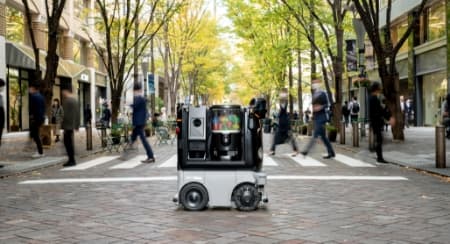
Mr. Kodaira: In terms of hard development, Toyosu Sail Park will mark the end of the project, but we don't think that's the end of it. For example, Toyosu Front and Toyosu Foresia, which we developed together with Mitsubishi Estate, are equipped with outdoor electrical and water facilities for use with food trucks and events, but they have not yet been fully utilized. While we continue to fine-tune the hard aspects, we hope to create new excitement in the area through soft and service-related initiatives, and to make the area a place where value is constantly being added.

Kaneko: In terms of revitalizing the community, there are not only corporate communities such as the Town Planning Council and the Smart City Promotion Council, but also groups established by individuals that have enlivened the town. I envision what it would be like for Toyosu in the future: it would be wonderful if we could create a place where such communities could interact with each other, creating a network that would lead to the growth of each community by inspiring each other.
Mr. Kodaira: I believe that in order to develop a good town, you need partners who can share and empathize with your vision. When Mitsubishi Estate became involved in the development of the Toyosu front, they established an organization (currently the "Toyosu Development Office") that specializes in the development of Toyosu, and when I heard about this, I felt their strong passion for the town development of Toyosu. Even in the subsequent project promotion, they have been fully open to our vision, and I am glad that we chose Mitsubishi Estate as our partner to work with us on the town development. I hope to continue to take on various challenges together with Mitsubishi Estate and other partners so that Toyosu can continue to be a town that can grow while protecting its essential value and incorporating new changes.